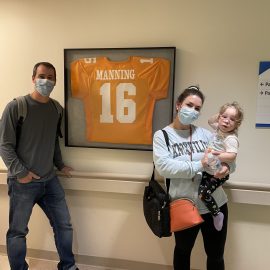

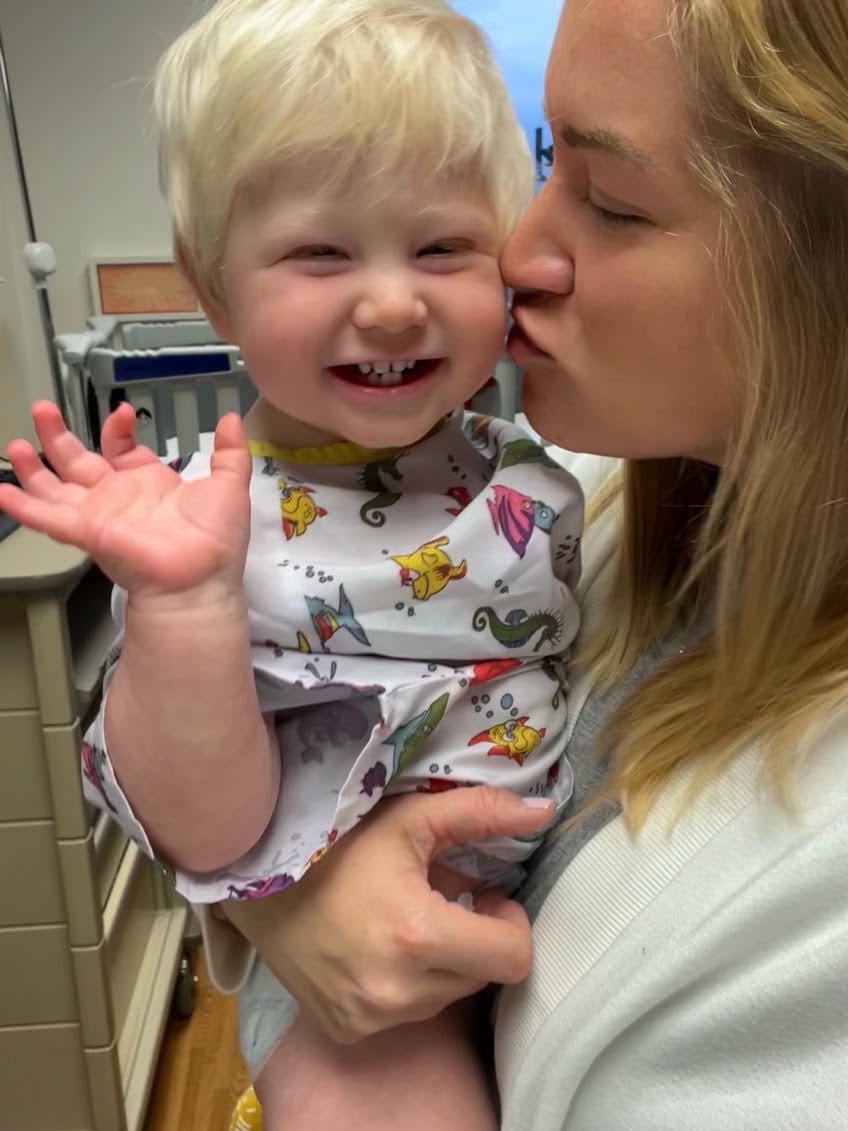
Stephanie Babcock, Mom to Jack Parker, shares her family’s journey with FEVR.
Understanding the Connection Between CTNNB1 and FEVR
Having a child with a rare disease, I have been humbled through my own learning process of the various associated conditions that go hand and hand with CTNNB1 Syndrome. After trying to learn as much as I could about CTNNB1 Syndrome itself, I learned about other conditions that my son, Jack Parker, nickname JP, is at a higher risk for.
One of the associated conditions that are commonly linked to children diagnosed with CTNNB1 is called FEVR. When I first hear of FEVR (I pronounce it like a “fever”) my mind made an immediate link to a fever that you get when you are sick. It’s not like that at all. FEVR, short for Familial Exudative Vitreoretinopathy (try saying that three times) is a retinal disorder that affects the development of the blood vessels in the retina. Upon learning the connection between CTNNB1 and FEVR, I also learned that FEVR can process quietly without any major obvious symptoms and the importance of early and routine monitoring for FEVR.
Jack’s First Eye Examination and Diagnosis
Jack originally started to see a pediatric ophthalmologist for strabismus concerns prior to our CTNNB1 Diagnosis. After learning about the syndrome and the elevated risk for FEVR, our ophthalmologist referred JP to a pediatric retina specialist (shout out to Dr. Kimberly Drenser!) who understood the importance of early detection. In August 2024, Jack underwent anesthesia for his first Fluorescein Angiography (in our medical chart this was called an “Exam under anesthesia” or EUA given my son’s young age) and sometimes for older children this exam can be completed in office without anesthesia. Our doctor explained this exam injects yellow dye (super fun when they pee neon yellow afterwards!) to look at the blood vessels on the retina.
Following the exam, which took less than 15 minutes, our provider shared that JP has FEVR in both eyes and at stage 1 and our treatment plan was to just monitor and complete another exam in one year. If your child is double blessed like JP with both CTNNB1 and rare inherited eye condition FEVR, I hope you find the humor when I say that after hearing this news, I went and bought a lottery ticket at our next gas fill up because I figured the universe kind of owed us, ya know? We didn’t win money off the ticket, but I learned that the universe did give me the gift of knowing what my next steps are and how best to support my son. That is a priceless gift that I am forever grateful for.
Two Years Later: The Importance of Routine Monitoring
And here we are in 2026 where my son has just completed his third exam under anesthesia and we are still at stage 1. Our physician shared that some children move through the stages quickly and the disease can progress quickly and compromise the retina. Other times the disease can stay in the beginning stages for many years. I’m thankful that our area has these speciality providers to educate and treat my son in his double fun diagnoses of CTNNB1 and FEVR and that when I come to doctors sharing what I learned from CTNNB1 Connect and Cure about the need for early and routine screening that they didn’t question. CTNNB1 Connect and Cure offered an easy to read and print brochure (FEVR-in-CTNNB1-Syndrome-Brochure.pdf) about the connection between both conditions that is an amazing resource to share with your child’s medical team.
Knowledge Is a Powerful Form of Hope
If there is one thing I’ve learned through this journey, it’s that knowledge can be a powerful form of hope. Learning about FEVR didn’t change JP’s diagnosis, but it changed what I could do with that information. It gave us the opportunity to screen early, find the right specialists, ask better questions, and keep showing up for the care he needs.
Rare disease parenting often feels like putting together a puzzle without knowing what the finished picture is supposed to look like. There are always new pieces to learn about, new specialists to meet, and new acronyms to figure out. Sometimes the best thing we can do is simply take the next step in front of us.
One Exam, One Appointment, One Step at a Time
For us, that next step is continuing to monitor JP’s eyes, continuing to learn, and continuing to advocate for him. Today, we are grateful that his FEVR remains at stage 1, and we’ll keep taking it one exam, one appointment, and one neon-yellow bathroom trip at a time.
A Message to Other CTNNB1 Families
If you are a fellow CTNNB1 parent who is just learning about FEVR, I hope our experience reminds you that you don’t have to know everything all at once. Ask questions. Find providers who will listen. Bring resources with you. And when you learn something new, share it with your child’s medical team.
Sometimes advocacy is simply knowing what questions to ask. And sometimes, the biggest gift we can give our kids is making sure the things that can be found early don’t go unnoticed.
Familial Exudative Vitreoretinopathy Resources for CTNNB1 Families & Their Clinicians
1. Learn more about FEVR in CTNNB1 Syndrome:
https://curectnnb1.org/fevr/
2. Download and share this brochure with your child’s medical team:
FEVR-in-CTNNB1-Syndrome-Brochure.pdf
Having a resource to bring to an appointment may help start a conversation about the proper eye exam to be done and if further evaluation is appropriate.